
That is why executive recruitment in AI has become increasingly specialised in 2026. For companies seeking AI executive search in San Francisco, the challenge is no longer simply finding people with strong technical knowledge. It is about identifying executives who can make sound decisions where technology, business strategy and rapidly changing markets intersect.
Imagine a company has just secured major funding. The product is gaining traction, customers are asking for more, and the board wants to move faster.
Then comes the difficult question: Who should lead the next stage of growth?
Finding someone who understands AI is one thing. Hiring an executive who can connect AI with product strategy, growth, security, finance, governance and wider business needs is another challenge altogether.
That is why executive recruitment in AI has become increasingly specialised in 2026. For companies seeking AI executive search in San Francisco, the challenge is no longer simply finding people with strong technical knowledge. It is about identifying executives who can make sound decisions where technology, business strategy and rapidly changing markets intersect.
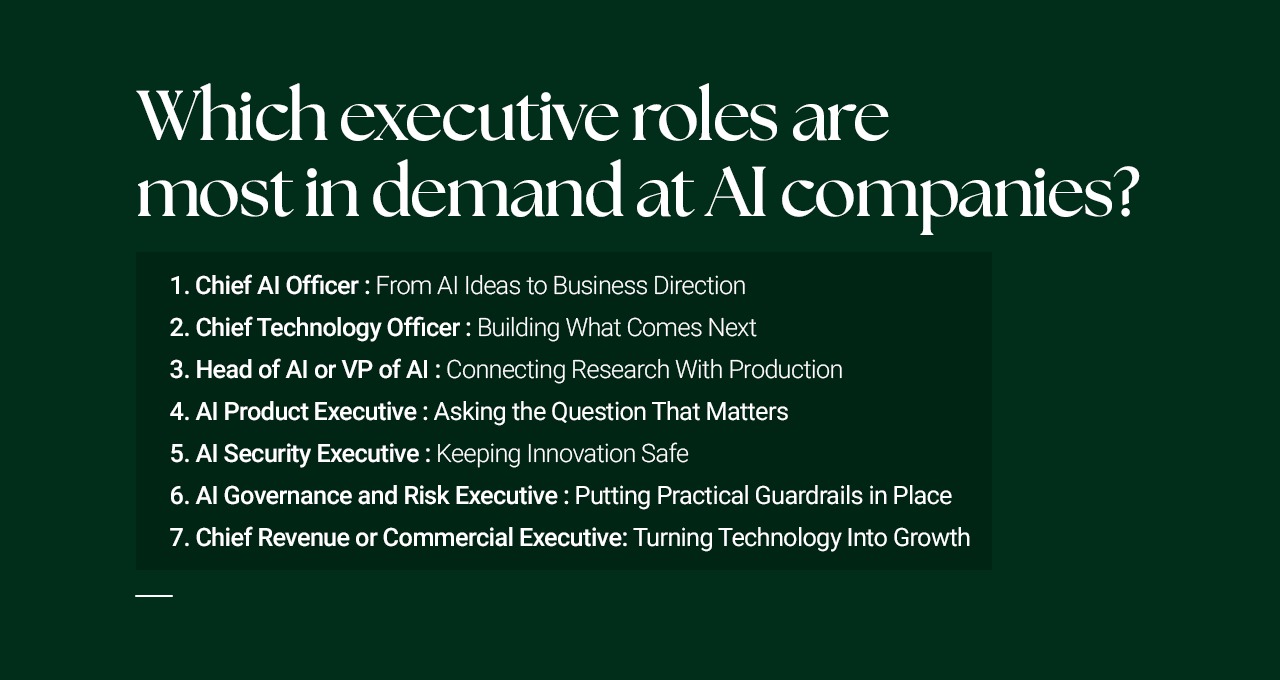
The seven leadership positions attracting significant attention include:
A company can have brilliant AI technology and still struggle to decide where that technology should take the business.
This is when the position of the Chief AI Officer becomes significant.
This individual usually sits at the crossroads of AI technology strategy and implementation and business priorities. Rather than being preoccupied with the technology itself, the function encompasses deciding where AI should generate value and what investments to make.
For a growing organisation, that means finding someone who understands both the technology and the commercial side of the business.
The CTO continues to be an important player in the leadership team, especially in AI companies creating advanced platforms and infrastructure or product offerings.
However, this role is not limited to just managing engineers.
As an AI company expands, its CTO will have to consider aspects like architecture, engineering hiring, infrastructure, product development, scalability, and technology strategy.
Strong candidates often need to move comfortably between technical discussions and board-level business conversations.
There can be a significant gap between what an AI system can technically do and what a business can successfully put into production.
The Head of AI or VP of AI could fill in this gap.
It depends on the company in question whether the executive in question oversees machine learning, applied AI, research, AI infrastructure or model building. They must be able to form teams who will be capable of translating these concepts from the laboratory into practical use.
In fast-moving businesses, this type of leadership can become particularly valuable.
Here is a simple test for any AI product:
Does it actually solve a problem someone cares about?
That question sits at the heart of AI product leadership.
Being an AI Product Executive entails an understanding of the customers, technology, and business goals simultaneously. An executive may be required to decide on what capabilities are worth investing in, how AI should be used in the product and in the user experience design.
The problem here lies in the fact that AI can advance in just a matter of weeks. An effective product executive will be able to tell the difference between something amazing and something valuable to the customers.
More AI adoption also means more questions around security.
AI security executives may play roles in securing models, data, applications, and infrastructure while mitigating risks posed by evolving AI solutions.
For organisations operating in sensitive industries, the stakes are considerably higher.
Think about a platform that serves the needs of financial organisations. Here, security is no longer an issue for engineers. It is a matter of customer trust, regulation, alliances, and scaling.
That is why the role of security executives is becoming an integral part of the executive discourse.
AI innovation can move faster than internal policies.
Such organisations require leaders who will pose difficult but critical questions, such as:
An AI governance or risk executive brings some much-needed structure to those kinds of questions.
Such a role is especially pertinent to companies that operate in highly regulated industries.
There is another side of AI leadership that should not be overlooked.
A company can build exceptional technology and still struggle to sell it.
A Chief Revenue Officer (CRO) or similar role is critical in translating complicated AI technologies into something that is meaningful to customers and that they will purchase.
This is especially true in dealing with bigger companies, financial organisations, and other organisations wherein buying involves more than one decision-maker.
A good commercial person knows his/her technology well enough to be able to talk about its value without making everything too technical in nature.
It is hard to hire any senior executive. However, the hiring process may be particularly challenging when a company seeks to hire a senior executive for a rapidly developing AI firm.
The ideal candidate should probably have worked in several markets rather than pursuing a completely linear career path.
This means that the candidate might have expertise in both AI and digital assets if hired by a financial institution, while the emerging tech company will be looking for a person familiar with the institutional finance market.
This is where specialist AI executive search in San Francisco can become relevant.
This is not about finding an executive who has listed ‘AI’ in their resume. It is about analysing the company’s current stage in its development, the market it operates in, the technologies it uses, the leadership gap and prospects.
The same applies when companies work with AI recruiters in San Francisco to reach senior professionals who are already employed and are not actively responding to job advertisements.
One of the most interesting developments in executive recruitment is happening where markets overlap.
There is an increasing connection between artificial intelligence, fintech, digital assets, and the more traditional financial industry. However, it can be hard to find people with relevant experience in these different sectors.
For example, when a bank wants to go into digital assets, it will require people who have experience in crypto but do not forget what happens on the institutional side of things.
In the case of a digital asset company, they will require leaders who know how banks and the capital markets function.
This kind of hire is different from your regular IT hire.
It requires someone who understands the language, expectations and working environments of both sides.
Spearpoint Search is an executive search firm built for companies that need senior talent quickly without compromising on quality.
Spearpoint takes on a limited number of mandates, typically no more than three searches each month, allowing every assignment to receive focused attention. Its searches are senior-led, with experienced recruiters bringing market knowledge, candidate insight and commercial understanding throughout the process.
With expertise across AI, digital assets, capital markets, fintech and emerging technology, Spearpoint is particularly well positioned to connect talent across Crypto/Digital Assets and Traditional Finance (TradFi). Its leadership podcast, newsletter, market content and senior network also help it engage experienced professionals beyond traditional headhunting.
For companies considering executive search firms for AI companies, this combination of specialist market knowledge, senior-led execution and focused search delivery can be particularly relevant when the role requires more than a standard recruitment process.
Spearpoint is not built around sending the largest number of CVs.
The focus is on understanding the mandate, reaching the right senior professionals and delivering a shortlist that makes commercial sense.
What are the top executive positions in AI companies for the year 2026?
Top positions include Chief AI Officer, CTO, Head of AI or VP of AI, AI Product Executive, AI Security Executive, AI Governance & Risk Executive, and Chief Revenue/Commercial Executive.
Why does the hiring of AI executives become increasingly specialised?
There is an increasing requirement for AI leaders to have knowledge in areas such as technical know-how, commercial acumen, product knowledge, security and market experience. There is an increasing requirement for multi-disciplinary AI executives.
Do AI companies only hire executives with technical backgrounds?
Not necessarily. Technical expertise can be important for roles such as CTO or Head of AI, but AI companies also need senior leaders across product, revenue, governance, security and strategy.
Why would a financial institution consider hiring people with experience in digital assets?
Financial institutions that are interested in venturing into digital assets would benefit greatly from having executives who have an understanding of traditional financial markets and digital asset markets. This would assist in bridging any gap that exists between the two markets in terms of technology.
What should firms take into consideration when selecting an AI executive search firm?
Firms can take into consideration some elements such as market experience, the involvement of senior executives in the search process, access to passive candidates, understanding of the firm's industry and identification of talented people in overlapping markets.
How can an executive search firm help an AI company find senior talent?
A specialist executive search firm can help define the leadership requirements, identify relevant senior professionals, engage passive candidates and assess experience against the company's market, stage and strategic objectives.